Sunday, December 6, 2009

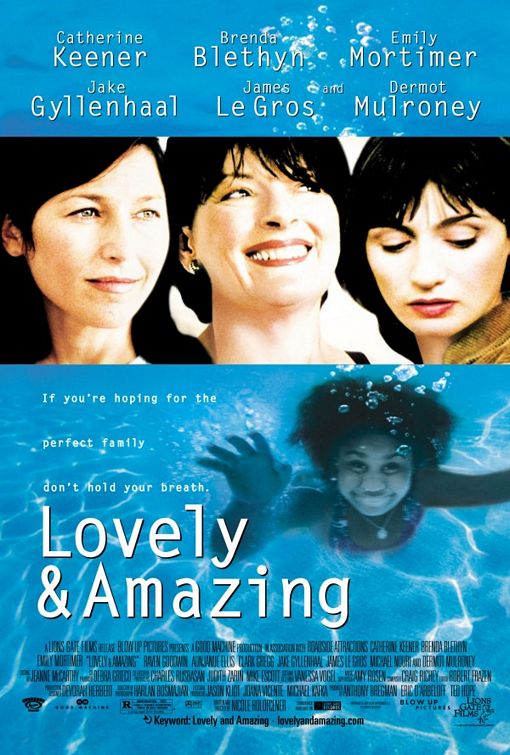
Lovely and Amazing Film Review


Lovely and Amazing, an indie film by Nicole Holofcner, is a story about 4 women, varying in ages, and there struggles to "better" themselves and become members of the world around them. It just so happens that these 4 women are all related. The mother, Jane, and her three daughters, Michelle, Elizabeth, and Annie, all have varying levels of body image issues that are dealt with in very different ways over the course of the film.

Annie, the youngest and only adopted daughter in the family, is African American, whereas the rest of her family is Caucasian. The difference in their races isn't really dealt with in this film, but it can be assumed that the issue will come up later on in her life. The problem faced in the film is that Annie is overweight for a young girl and she sometimes binge eats cookies. In the movie she said that she didn't think the cookies were unhealthy, so she ate them. She gets in trouble for eating like that but it doesn't deter her hunger. At the end of the movie, there is a scene where she buys a large amount of food at a McDonald's, but claims that she isn't going to eat it all. She also convinces her Big Sister to use a relaxer to straighten her hair, so she could look more like her white family.

Elizabeth, the daughter who seems the most normal, deals with her body image the most because she is an actress trying to break into the business and that business is very harsh and critical. On top of that, she struggles with being the most responsible sister, as her mother asks her to take care of Annie, if anything were to happen to her. Elizabeth's lack of self-esteem culminates when she starts an affair with an actor, with whom she couldn't be cast as a love interest. She then asks this man to tell her all the things that are wrong with her body and he doesn't hold back (after an initial hesitation). It is obvious to the viewer that his critique of her body only further decreased her self-esteem level.

Michelle, the eldest daughter, is married and has a daughter. She doesn't have a job and sits home and watches cartoons all day, which infuriates her husband who works all day. At first, to make money, she creates these tiny chairs, which she hopes she can sell, but that doesn't pan out. She then gets a job at a one-hour photo place and to boost her self-esteem, she starts an affair with a 17 year old boy. I don't think the affair went further than flirting and kissing, but ultimately they get caught by his mom and she gets arrested for statutory rape. Needless to say, her marriage ended subsequently.

Finally there is the mother Jane, who I think unintentionally fostered all of these problems in her children. She is a single and wealthy woman, who never found true love and that is what she is after. Jane thinks that by having liposuction, she will become more desirable and find love. She even develops a crush on her surgeon, which doesn't work out, because he is happily married.

Overall, I think this was a good movie with a good message that is hidden in all the ways that women limit themselves and worry constantly about how they appear to others. Body image issues plague women starting from a very early age and don't ever really stop. These women were dealing with so many body image issues that they started to lose sight of who they were as people and as a family. Even though the ending was abrupt and unexpected, I hope that these women found that love and acceptance starts from within and there's no better place to find that love than with a family.

Friday, December 4, 2009

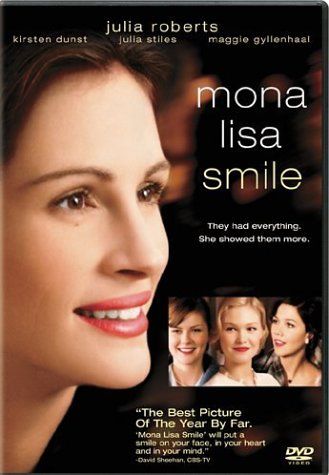
Mona Lisa Smile Film Review


Mona Lisa Smile is a film based in the 1950's at Wellsley College, a institution for higher learning for women in that time period. The only difference between the women today (mostly) and the women, in this movie, is that they were in it solely for their MRS degrees. More often than not, the young ladies who attended Wellsley College in this movie would end up married and on their way to having children before they even got close to graduation. Women in this time period were only good for one thing and that was to become someone's wife and someone else's mother. No one was concerned with the academic development of these women. It is my personal belief that these women were enrolled in college just because they had the money from their parents backing them and so they could hold good dinner conversation with their husband's bosses and bosses' wives. The film follows the story of five different women and how their paths at this college changed each other's lives. Katherine Watson (played by movie vet Julia Roberts) was a very liberal and "subversive" instructor from California who couldn't understand why a woman would want to limit herself to just being known as someone's wife. While most of the girls found her interesting, there was one girl who opposed her every step of the way. Betty Warren, portrayed by Kirsten Dunst, was one of the women that believed that she was completely justified in her choices to become engaged and later marry someone, putting her betrothed above her education, by skipping classes and fighting Katherine Watson's teachings. After seeing how Wellsley was teaching these girl's to act, Professor Watson used her lectures to show the girls that there were other methods out there and they did indeed have choices outside of becoming someone's (in)significant other.

The overall theme of this movie had to do with change. But the change was different for each of the main characters. In Joan Brandwyn's case (Julia Stiles), she was a more progressive student, who wanted the best of both worlds. She wanted the education (going to law school) and she wanted the husband and children. In the end, she realized that although she wanted both, she wasn't willing to sacrifice her future family by being selfish. While I don't exactly understand her choice, I admire her for being so selfless. In Giselle Levy's situation (Maggie Gyllenhaal), she was the promiscuous student that everyone talked about and who had a ongoing affair with one of her professors. She was confident in her sexuality and even used taboo birth control pills openly. I think that by the end of her experience with Katherine Watson, she realized that she was better than random sexual relationships with men that didn't care about her. For Connie Baker (Ginnifer Goodwin), she struggled with body and confidence issues and her situation wasn't helped by some of her friends and her relationship with men. By the end of the movie, she transformed into a much more confident woman who didn't need the approval of her friends or any man to make her happy, although she got the guy at the end. Betty Warren is a very difficult case. She was influenced by her mother from a young age to act a certain way, to look a certain way, and she took that to a very extreme level. She was constanly angry and trying to smash the happiness of others because deep down she wasn't happy with herself. I think the kicker was that when her husband cheated on her, publicly, her mother told her to suck it up and deal with it like a married woman, basically ignoring his indiscretions. Ultimately she chose her happiness over keeping up appearances and that all had to do with one woman. Katherine Watson, from the very start, came in with a mind to change the mind's of those women right away without taking into account their feelings at all. She wanted to change their minds about becoming housewives. She wanted them to see that there was a way to get both, or if they wanted just to have an education, it was okay to do that too. At the end, she realized that not only couldn't she change those women, if they were set in their ways, but she couldn't change her own mind about her beliefs, and so she departed from Wellsley.

I love the movie Mona Lisa Smile. It is just such an uplifting movie and gives a good message and lesson about the choices that women are forced to make even to this day. It was interesting to watch from an academic perspective and really analyze the women and their issues, and how it affected their body images.

Sunday, November 29, 2009

First Off, Let Me Just Say That There Is No Way In Hell I Would Let A Man Throw Bologna At My Butt!!! Film Review 3 - DreamWorlds 3


Secondly, I would just like to say WOW! I'm am completely amazed at the information that was presented to me while watching "DreamWorlds 3." Most of the information, I admit to being previously aware of, but the stats and other extreme images and situations were definitely surprising, to say the least. Now that I have gotten that out of my system, I can respond to the documentary. And I'll try to keep my language PG-13 at best. I honestly don't know where to begin with this response. There were so many aspects of that film that were just so horrendous to even imagine let alone be bombarded with over a very short period of time. I think instead of starting with the things that the film got correct, I'll start with the things that I didn't necessarily agree with because that is a much shorter list.
The first thing that I didn't agree with was the way the film portrayed a particular Robin Thicke video which featured his wife, Paula Patton. While it does present the female as a sexual being still, the filmmakers overlook the fact that she is indeed his wife, who he can look at that way. For people who know they are married, it would seem that instead of an R&B star covered by all types of women, there is a man, who is completely committed to his wife and upholding a monogamous relationship. He finds his wife sexy and their is nothing wrong with that; in fact, monogamy, which is not often seen in popular culture, should be portrayed more and not negated due to a little female sexuality.
Overall, the part that I disagreed with the most was the section about female performers being trapped by masculine control. I admit, there are some female performers out there who fall prey to this control unknowingly and unwillingly, but there are plenty of women who do it on purpose to prove that they are in control of their sexuality and they have the power. Christina Aguilera is a prime example. When she first became a pop icon, she was portrayed by the music industry as an innocent little girl with no real control and she wanted to break free of that mold. On her second album, there were much more sexual themes, but she was the one who made the decision to portray herself in that manner, to let people know that there was more to her than a naive little girl, which in itself is a masculine fantasy. Other performers include Madonna and Janet Jackson. These women are perfect examples of performers who can reinvent themselves and emphasize different facets of their personalities with each new interpretation of themselves. People think that just because a woman decides to be sexual once, means that she will always be sexual and that is simply not the case, in my opinion. Lastly, a female that I really admire for their bravery in performance art is Lady Gaga. Her style is truly her own and she doesn't give a crap what anyone says or thinks. Her songs have a powerful message and always portray her as the one in control and that is alright with me.
Women are constantly portrayed in the media, especially in the music industry, as fragments of an entire person. The female body is shown in sections, often with the face being the least part seen. The breasts and derriere are the most commonly acknowledged parts of a female and are in some ways revered and in others degraded. Inherently, there is nothing wrong with showing a woman shaking her hips or butt, because who hasn't danced in their rooms or just around, with no cares for what anyone else is thinking. What creates the problem is when artists, particularly male artists, degrade a woman to being nothing more than a glorified prostitute showing off her butt and even her "lady parts." The group of people that are the most guilty of this are the rappers and the rock stars who believe that they have the ability to just dispose of women so easily, that they can be portrayed as naturally sexual creatures, often times with homosexual tendencies, who enjoy being treated like objects. Basically men are the possessors and women are meant to be possessed. I think that is a terrible quality to advertise to today's youth, both males and females. And when people take the images portrayed on television and force them into reality, it becomes a whole other cautionary tale. There is no reason for women to have to walk down the street living in fear of being assaulted by men, but how else can this culture evolve. Seeing the video and photo from those two public incidents in which women were attacked and treated like their "video ho" counterparts was disgusting and made me sick to even think of that happening to anyone I know. I hope that people will take into account all of these things and make sound decisions about how they act in the real world and separate that from the pornographic images seen in music videos.

Blog 10 - Body Image Playlist

Music is one of my main passions, so making this playlist relatively short was darn near impossible. I picked what I think is an eclectic mix of songs from different genres, minus country, but that is just because I couldn't find one that I liked. Body image in music, to me, is a mix of positive and confident messages. All of these songs at one point in my life have been a big part of my development as a woman. I went through all of the phases that a typical teenage girl goes through, but these songs definitely helped me deal with a lot of conflicting emotions. My taste in music has definitely changed over the years, because even though they were degrading, I listened to all of those rap songs that talked about women's butts and other assets. Rump Shaker by Wreckx N Effects is a great song, but very degrading! Anywho, I tend not to listen to those anymore, because they have just grown to such a disgusting level of degradation. T 'n' A has become the forefront of all of the major media markets that pure and innocent talent is very hard to come by these days. The "video hoes/vixens" are letting themselves be used for strictly their bodies and completely set women back a few decades in the way of the feminist movement.

Anyway, I hope you enjoy my playlist!!


Get a playlist! Standalone player Get Ringtones!

Sunday, November 15, 2009

Pop Culture and Gender


I am a huge fan of reality television. From action-filled to love shows, I am interested in pretty much all of them. Since I watch all of these shows I am often bombarded with advertisements and portrayals of men and women in both positive and negative lights. As I'm writing this blog, I'm watching VH1's "Tough Love" which features women with different personal flaws, looking for love with the help of a brutally honest matchmaker. Each of the women possesses the worst qualities that a lot of women have when it comes to the opposite sex, but it doesn't at all portray any of these women in a positive manner. What disturbs me the most about this show (even though I can't stop watching it) is that they don't have a tough love for men. They have a show called "Tool Academy" but most people view those qualities as funny or entertaining, while the negative aspects of women are not entertaining and make the entire gender look bad. I don't allow any of these shows to influence how I view life, because I know that it is mostly fake. It also hasn't affected my understanding of race and class, because everyone seems to be on the same level when they enter these situations. More often then not, I don't discuss the sexist nature of these shows at all, because they don't really affect my life personally. But I definitely do realize the sexist nature of the shows. Some of the commercials that come with these shows are GGW-esque and definitely are one-sided advertised towards males. When I think of the word "feminist" I used to think of negative connotations of women who hated men completely. After taking this class, I definitely think of feminists as really strong women who just don't take any crap when it comes to inequality. I honestly believe that I am feminist in some aspects of my life and I strive to be strong enough to stand up for what I believe in when it is important to me. I really enjoyed the readings this week by the way. They are exactly the type of readings that I enjoy, because they are straightforward and don't hold back on the truth just because it might hurt someone's delicate sensibilities.

Monday, October 26, 2009

Blog 8 - Check My Title


The most interesting read to me in Body Outlaws was "The Butt: Its Politics, Its Profanity, Its Power" by Erin Aubry. I come from a family (well at least on my mom's side) that are all petite with wide bottoms. It is something that I have had to deal with my entire life, or at least since puberty hit. Unlike the author of the piece, I am plagued with wide hips more so than a large derriere but overall the lower half of my body is much more prominent than anything else. What my butt says, goes. It took me a while to start to appreciate my body in its entirety. When I was younger (middle school age) I was the one in the group with the largest posterior, which is still true today, and people often commented on it. It's like I walked around with a sign on me, saying wide load on my back, and that made it okay for people to say whatever they wanted. As I have matured and become more comfortable with all my body has to offer, I understand that my butt is just a relatively large part of a whole package and any person who wants to be in my life has to accept me, butt and all.
Now, after reading the end of The Beauty Myth, I do not feel one ounce of closure. I know there is not a lot the author can do to change the problems that we have today with body image and female confidence, but I feel like she just beat around the bush when it came to the ideas and didn't face them head on. Wolf gives the option of eating what we want and wearing what we want to combat the negative influences that dominate our lives, but if it were the solution was that simple and passive, than why hasn't it already happened. I am a firm believer in confronting the issues head on and I think Jessica Valenti is definitely the kind of reader I want to stand behind. In class, I know a lot of people felt assaulted by the use of profanity in her text, but I think it just gives people that extra shock that makes people take notice of what is going on around them. A person can use professionally and highly educated language everyday and never really get down to the root of the problem. I think that Valenti just made the feminism issue that much more relatable to a lot more women all across the world.

Saturday, October 10, 2009

Food Nation . . . Blog #7


An eating disorder is "condition which affects an individuals eating habits, either as a result of their own doing (self-inflicted), or as a bodily reaction to the consumption of food." (Wikipedia) People, especially women, have always struggled with the notion of beauty. As beauty has changed over time, so has the intense battle to fit the new concepts of beauty. In the media, especially in the fashion industry, going all the way back to to the "heroin-chic" period when it was considered beautiful to be so skinny that you could see a model's ribs and spine. I'm sorry but nothing about seeing bones on a person's body is okay to me. And the diet industry has not helped either. There is an abundance of dieting commercials with celebrities in them that make it seem okay to diet. And while eating healthy is not a bad thing, the assault of visual images about losing weight can cause a complex on impressionable young minds. Preoccupation with appearance has become society's addiction and a ritual that is more and more common among young women. Because we live in a consumer based world, we are always trying to fit into the products that are made for us. There are many designers that only make clothing for size 0 people and even though that is not realistic, people will strive to fit those extra skinny jeans, and starve themselves to do it. What we need in society is designers willing to spend the extra money on fabric and make clothes for normal women, so that young people aren't trying to fit into an impossible standard. What we need is women willing to stand up and say that I'm not a size 0 and I am proud of it. Society can be reintegrated when we can find those people willing to do fight back against those standards that can't be attained by the majority of society. Eating disorders are a plague on society but they can hopefully combated with the right influences and the view that we are perfect the way God made us.